


Cerebral palsy care

What is cerebral palsy home care?
Cerebral palsy care helps you or your loved one to live a full and independent life at home.
If you live with one of the many types of cerebral palsy, you can still live a fulfilling life, comfortably and in the way you want to – with specialist support to help you when you need it.
With over 35 years of experience in providing specialist home care, we provide live-in care and visiting care for people with cerebral palsy within the comfort of their own homes. One of our expertly trained and specially chosen carers can provide all the one-to-one assistance required, whether that is medical help, personal care, help around the home or ongoing companionship.

What are the benefits of receiving cerebral palsy care at home?
Maintain your routines and lifestyle
You’ll be able to continue with your normal routines, hobbies and lifestyle while receiving all the support you need for your cerebral palsy
Condition-led care
We work closely with individuals, families, physios, hospitals, GPs, and speech therapists to ensure the care we provide is right for your cerebral palsy
Personal, one-to-one support
You’ll benefit from receiving one-to-one support from your own carer, who will get to know your condition and your specific care preferences
How to choose the right carer for someone with cerebral palsy
Our carers are expertly trained to provide you with holistic, flexible support for your condition.
The existing routines and lifestyle of someone receiving support are sometimes forgotten about. However, with Helping Hands, we build our care around each of our customers. This enables our cerebral palsy support workers to meet the requirements of you or your loved one, by providing care that meets the high standards we set ourselves. Here are some of the many ways in which your carer can help you:
Catheter care
When needed, our carers can step in to provide medical support with catheters on a short-term or long-term basis
Stoma support
If you have a urostomy or stoma and you require support, supervision or full assistance with managing it, your carer can help out
Mobility support
All of our carers are trained to provide safe and secure mobility support, so can help you get in and out of bed and move in your home confidently
Personal care
Your carer can support you with discreet, dignified personal care, including helping with toileting, bathing and getting dressed every day
Help with medication
Every Helping Hands carer receives training in assisting with medication, including collecting your prescription and helping you administer it
Household chores
As well as providing nursing care, our carers can provide practical support around the home, such as vacuuming, cleaning, tidying and preparing food
What does our cerebral palsy care include?
Your care plan will be fully tailored to your specific circumstances, needs and preferences.
By choosing Helping Hands for your home care, you’ll get a care plan that is completely based upon your needs and requirements. We place special importance on matching you with someone who has the same interests, likes and dislikes. Our cerebral palsy support workers are assisting people every day to live the lives they want, whether that’s supporting them at home, at work, through study, on holiday or through active social lives.

How much does cerebral palsy home care cost?
Cerebral palsy care case study
Read about the difference our home care is making to Kathleen
What is cerebral palsy?
Explore the different types and causes of cerebral palsy
Cost of cerebral palsy care
Find out what cerebral palsy care from Helping Hands might cost
Care that supports your independence
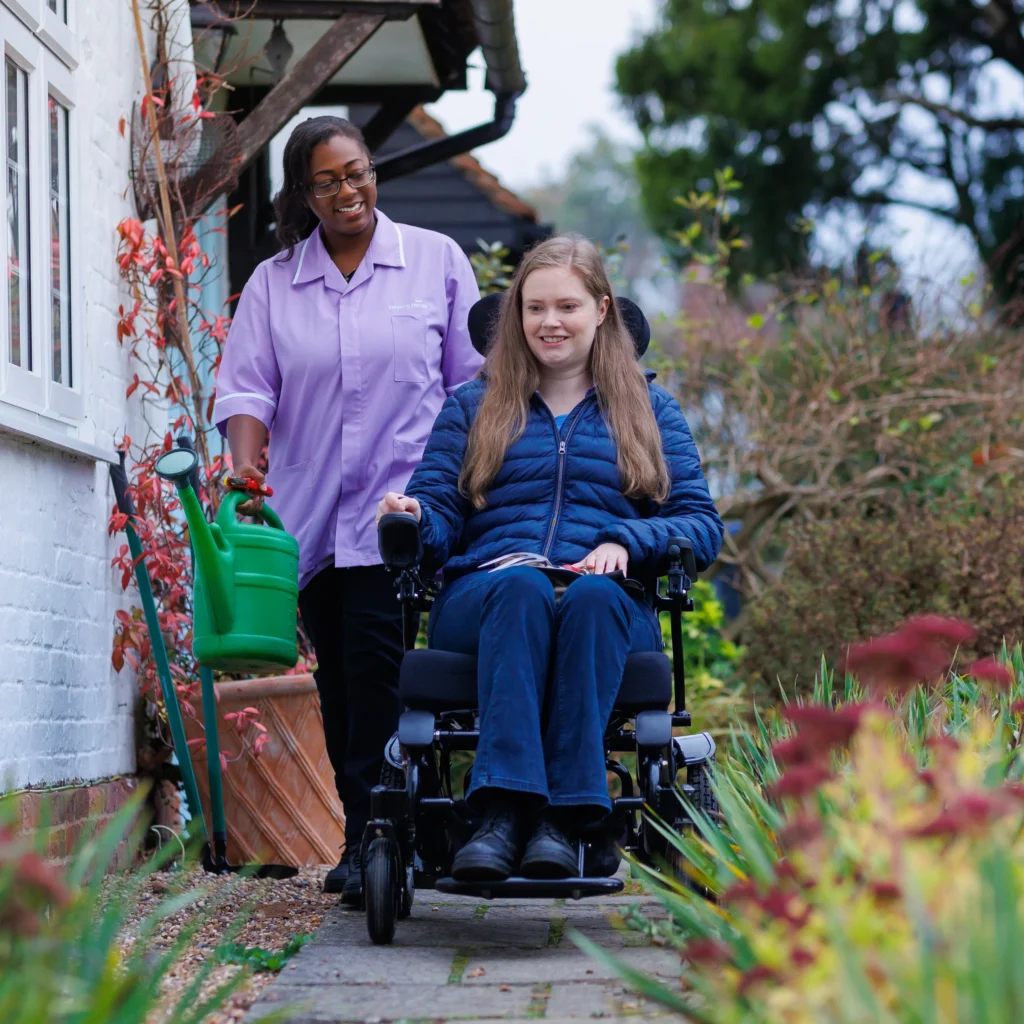
Find out how home care supports Hannah to life a fulfilling and independent life.
Meet Hannah, a bright and bubbly 27-year-old with a great sense of humour and positive outlook on life. She loves music and was even lucky enough to watch the Rolling Stones live at the London Stadium in 2018! She also lives with cerebral palsy and has done since birth. Since starting care with Helping Hands in March, she describes her experience as “life-changing”. Watch the video to find out how weekly visits from Dana have totally transformed Hannah’s life.

Are there different types of cerebral palsy?
There are three main types of cerebral palsy, and many people may have a mixture of the following.
Spastic cerebal palsy
This reduces the person’s range of movement due to the muscle tone becoming tight and stiff. It can be very painful when muscles go into spasm and can affect different areas of the body.
Dyskinetic cerebral palsy
This causes involuntary and uncontrolled muscle contractions and is difficult to uphold an upright position. It may also be difficult to control the tongue, vocal cords and breathing which can affect speech and language.
Ataxic cerebral palsy
This means the inability to activate the correct pattern of muscles during movement, leading to affected balance and spatial awarenss. It can affect the whole body and cause walking to be unsteady and shaky.
Does cerebral palsy get worse over time?
The Cerebral Palsy Research Network says that the brain injury that causes cerebral palsy is not progressive, it’s affects on the body can change over time. 40% of adults with cerebral pa;sy could walk during their teenage years but lost this ability over the course of two decades. If this affects you, remember that Helping Hands offers personalsied mobility care that adapts to your range of movement and can put daily exercises in place for your benefit.
Hear from people with similar conditions
We love sharing stories about how our carers are supporting their customers in their homes, communities and beyond! Read about how we’re helping two of our amazing customers, David and Martin, to live life to the full and manage the symptoms of their conditions.

David

Martin
What our customers are saying
Read some of the Trustpilot reviews that our wonderful customers are leaving us:
Arranging cerebral palsy care
When caring for a young person with cerebral palsy, the idea of welcoming someone new into the home can be daunting. At Helping Hands, we’re here to walk you through each step of your care journey with us.
Speak to our team
Our friendly, knowledgeable team can answer your questions and talk you through your options. We are available 7 days a week.
Book a free care assessment
Your local Helping Hands care manager will visit you to understand your needs and preferences and discuss how we can help. We can visit you at home, in hospital or even a care home to carry out the care assessment.
Confirm your care package
We create a tailored care plan for you to review. Once you’ve agreed the plan, we can organise care in as little as 24 hours.
A fully regulated home care provider
Here at Helping Hands, our service is regulated by the Care Quality Commission (CQC) and the Care Inspectorate Wales (CIW).
This means we need to consistently meet high standards and are monitored by our regulators.

Why is being a regulated care provider important?
Independent inspections of our service, giving you peace of mind
Fully vetted, high-quality carers
Guaranteed training and development for our staff
Page reviewed by Honor Elliot, Clinical Manager, on April 22, 2026.
How we wrote this page
This page has been produced referencing key insights and data from external experts, trusted medical sources and our team of in-house specialists. We have worked hard to ensure that all information is as accurate as possible and reflects current consensus at the time of writing and reviewing.