What goes into a live in care support plan?

What is a support plan?
A support plan gives the live-in carer a detailed outline of their customer’s care needs.
Every customer has a support plan that is created during the initial live in care assessment by the local Live-in Care Manager and the customer before care begins. Some customers choose to have family members or 24-hour care professionals – such as occupational therapists or social workers – present during the assessment, which can often help with providing all of the information the Live-in Care Manager will need.
A digital copy of the care plan is sent to the customer, and a paper copy can also be requested. This may contain:

What information is included in a support plan?
It follows the Activities of Daily Living nursing-based model, which identifies key factors that aid independent living for the individual receiving care, such as maintaining a safe environment, communication, mobilising and sleeping. The following information is included in a Helping Hands live-in care support plan:
Personal details
Name, address, next of kin contact details, GP and other health professionals, Power of Attorney (if in place), Do Not Resuscitate document (if in place), other people living in the property
All about me
Life history, interests and hobbies, end of life wishes, how you like your home to be kept, what you want to achieve from care, medical and health conditions
Mobility requirements
Mobility aids, moving and handling requirements and risks, physical disabilities, equipment available, details on how to transfer you to your bed, toilet, chair etc
Personal care
What you need support with and how, and what you would like to do yourself. For example, you may have a bed bath every morning but prefer to wash your face yourself.
Medication
What type of medication is required, how it is administered, who administers it, allergies, pharmacy details (more information in Medical Administration Record [MAR] chart)
Nutrition and hydration needs
Preparing meals, dietary requirements, allergies, administering food i.e. PEG feeding or if you need your food cutting up by your carer
Live-in carer requirements
Where they sleep, food arrangements, break arrangements, other carers involved i.e. visiting carer for moving and handling procedures
Environmental needs
Fire evacuation procedure, ease of access around home, location of gas and electric meters etc
Risk assessments
Compiled with clinical support plans and supported by Regional Clinical Leads
Helping Hands provide a truly excellent home care service…a fully documented care package was arranged at very short notice.
E. Cummins, Trustpilot review

How is a support plan formed?
Our support plans are always formed with you and your needs at the centre of everything.
The support plan should be tailored around you and your specific needs and requirements, whilst giving as much information as possible for your carer to provide the very best care for you.
To ensure that the customer’s best interests come first, we always uphold the Mental Capacity Act and ensure that we create a support plan that adheres to the wishes of the customer. If a customer has a Power of Attorney and is unable to make decisions about their care, we will ensure that their nominated individual(s) is fully involved in the support plan process.

How often are support plans reviewed?
Support plans are reviewed every six months, and every three months in Wales.
There may be reasons to update your support plan sooner than every six months – for example, if your health condition changes, or elements of your property change. This can be initiated either by your live-in carer or yourself.
The process of this review mimics the initial assessment that took place before care started, the local Live in Care Manager will visit you in your home and go through all aspects of your care needs, often with a family member or care professional present too.

Meet Live In Care Manager, Wendy Sear
Wendy Sear is one of our CQC accredited live-in care managers, fully committed to providing you or your loved one with home care tailored around your needs.

Wendy Sear
Live-in Care Manager
What input do I have to my support plan?
Creating a plan to support your independence is very much a collaborative process.
The Live in Care Manager will work very closely with you when creating the support plan, ensuring that both your practical and emotional well-being are catered for. It’s important that you raise any concerns in order to reach an agreement to the care being provided and the specific outcomes you want to achieve.
So, if you love going to your local park to feed the ducks once a week but need support with your mobility in order to get there safely, those exact preferences and instructions will be noted and actioned in your support plan so that you can live the life you want to lead, just with a little support along the way.

What are the benefits of care at home?
Care at home lets you get the support you need without having to leave the home that you love. At Helping Hands, we firmly believe that your own home is the best place for you to receive the support that you need, as it lets you retain your independence in a comfortable, familiar environment. With the help of visiting care or living care you or your loved one have the choice to stay in your own home and continue living life on your own terms.
There are many reasons why people choose a live-in carer or support worker instead of visiting care or moving to a residential care home, such as:
Flexible support to suit you
Your carer will be able to support you as much or as little as you like, and can focus on helping with certain things if you’d find that useful
Maintain hobbies and routines
Whether you enjoy meeting friends for a cuppa, going to church or playing board games, you can continue with your favourite hobbies and routines
Friendly companionship
Whether it’s sharing meals, watching TV or enjoying days out, our carers make for fun, friendly companions and often become friends for life
Enjoy your own home
Enjoy all the benefits of being in your own home – your favourite views, your own furniture and furnishings, the familiar neighbourhood, and more
Choose when to see loved ones
Your family and friends can still come and go as normal at the times that suit you, and you’ll also be able to visit them with the support of your carer
Avoiding change
The extra support that live-in care provides means your daily life can stay much the same, and you can stay put rather than having to go through the stress of moving
Taking care of the people that care for you
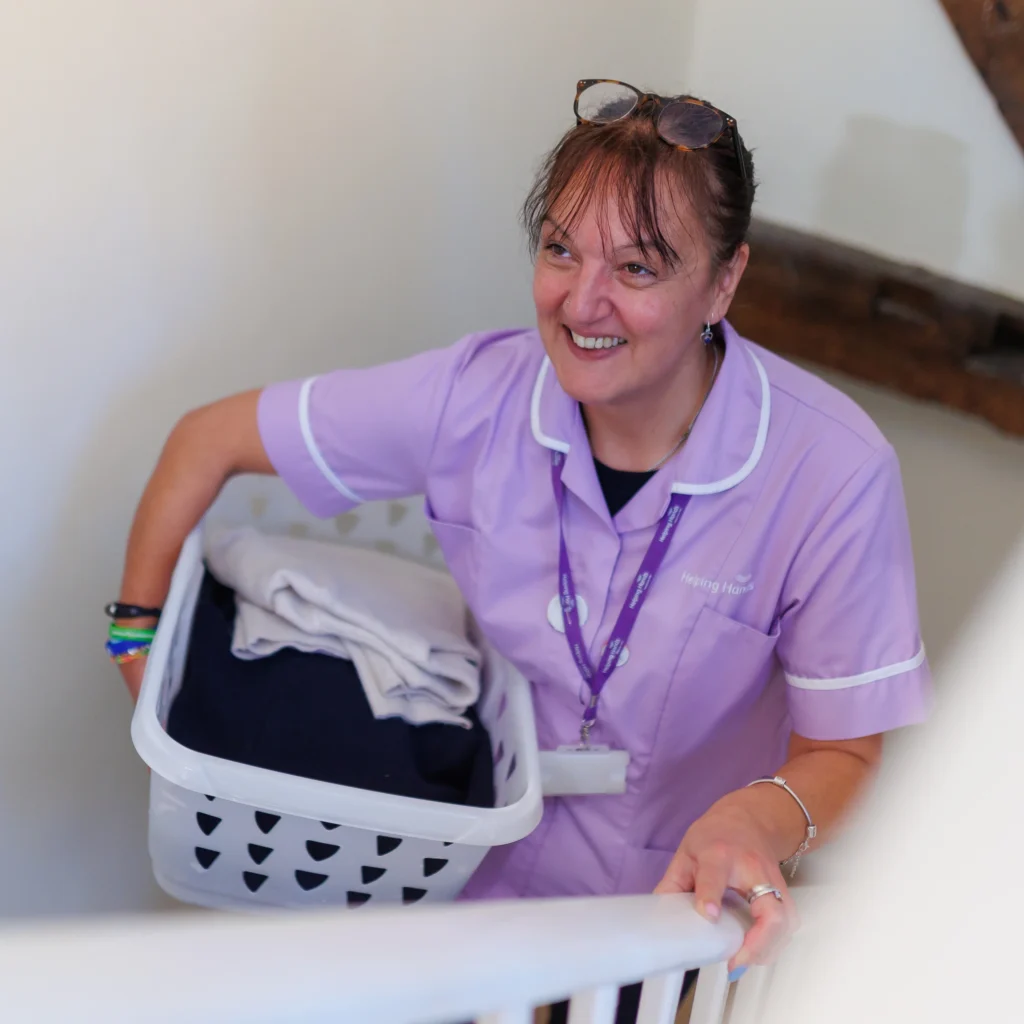
Our wonderful carers are the reason we’re trusted by so many families to provide care and companionship to people who need support.
We directly employ every one of our carers and regularly train, support and reward them so they can continue to deliver the best care.
How to arrange live in care
We know that arranging care can be a daunting process, which is why we focus on making it incredibly straightforward to organise support with us. Call our team today to begin your journey.
Speak to our team
Our friendly, knowledgeable team can answer your questions and talk you through your options. We are available 7 days a week.
Book a free care assessment
Your local Helping Hands care manager will visit you to understand your needs and preferences and discuss how we can help. We can visit you at home, in hospital or even a care home to carry out the care assessment.
Confirm your care package
We create a tailored care plan for you to review. Once you’ve agreed the plan, we can organise care in as little as 24 hours.
A fully regulated home care provider
Here at Helping Hands, our service is regulated by the Care Quality Commission (CQC) and the Care Inspectorate Wales (CIW)
This means we need to consistently meet high standards and are monitored by our regulators.