


Coming out of hospital at Christmas: what families need to know

Why hospital discharges increase before Christmas
If you were to ask people whether they’d rather spend Christmas in hospital or in their own home, it’s obvious that most would rather spend the festive season in familiar and comforting surroundings. NHS staff also understand that people want to be discharged before Christmas and do their upmost to ensure that anyone who can be safely sent home, is. According to Healthwatch, “People waiting to leave hospital are discharged more quickly and efficiently in the run up to Christmas than at any other time of year.” This also means that beds that are needed for more clinical cases can be freed up during the coldest time of the year, when people with preexisting conditions may see their health at risk of deteriorating. Also, the presence of family members over the Christmas period means that people who normally live alone may have support at home that they wouldn’t normally.

What to ask before your loved one leaves hospital
It’s important that loved ones ask questions before their loved one is discharged, such as what their care plan will involve and whether community support will be supplied.
Their discharge plan
A discharge plan will be put in place so that care continues once the person leaves hospital. The plan will contain detail about where the person is being discharged to, such as their home, a loved one’s home, or a care home. It will also say whether home adaptations or specialist equipment are necessary before discharge.
Medication and follow-up appointments
The discharge plan will contain information on their GP, consultant, ongoing medical treatments, follow-on appointments, and detail of medications being taken. It will also detail community or district nurse visits, as well as information about local day care services. Medication should also be arranged before leaving hospital.
Getting the home ready for their return
Other healthcare professionals will also be involved in the planning process, such as occupational health and community nursing teams. They will work together to ensure that everything is in place prior to discharge, including any home adaptations and specialist equipment. Care may also need to be arranged; some people arrange it privately, through companies such as Helping Hands, whereas for others it will be provided by the NHS or local authority. A discharge plan is essential when someone is to be sent home from hospital as it will ensure that the person’s progress is mapped. A plan for essential care in the community is necessary so that daily tasks such as dressings can be changed, medication monitored, and physiotherapy delivered in a timely manner.

Planning around Christmas closures
GP surgeries are usually closed over the festive period, while not all pharmacies are open over Christmas. They will usually run on reduced hours on a rota basis.
GP and pharmacy opening hours
The NHS will have a rota in place that ensures help and advice can always be obtained from a local pharmacy, even on shorter hours. The NHS 111 emergency prescription service can be used for last-minute medication orders, or 111 to speak to a medical professional. Or, in an emergency, the local A & E department can be visited.
Who to call if things change
If medical advice is needed on a non-emergency basis, then a pharmacist or pharmacy assistant can be consulted. The NHS 111 service will also mean that advice and reassurance can be obtained around the clock, if loved ones are not sure whether they should take things further. If in doubt though, call 999 or go to your local A&E.
Signs recovery isn’t going to plan
While being discharged from hospital in time for Christmas is what most people would want, it can affect recovery if the care plan isn’t followed closely. “The period immediately following discharge is among the most clinically vulnerable in a person’s recovery” say Nurseline. “Around one in five people discharged from an acute mental healthcare unit in England were readmitted within just six months”. This demonstrates how fragile the period after discharge is, and how the recovery process can break down if adequate follow-on support is not in place. If symptoms worsen, the person’s energy drops, they seem more confused, or have become frailer, then medical intervention should be sought as a matter of urgency.
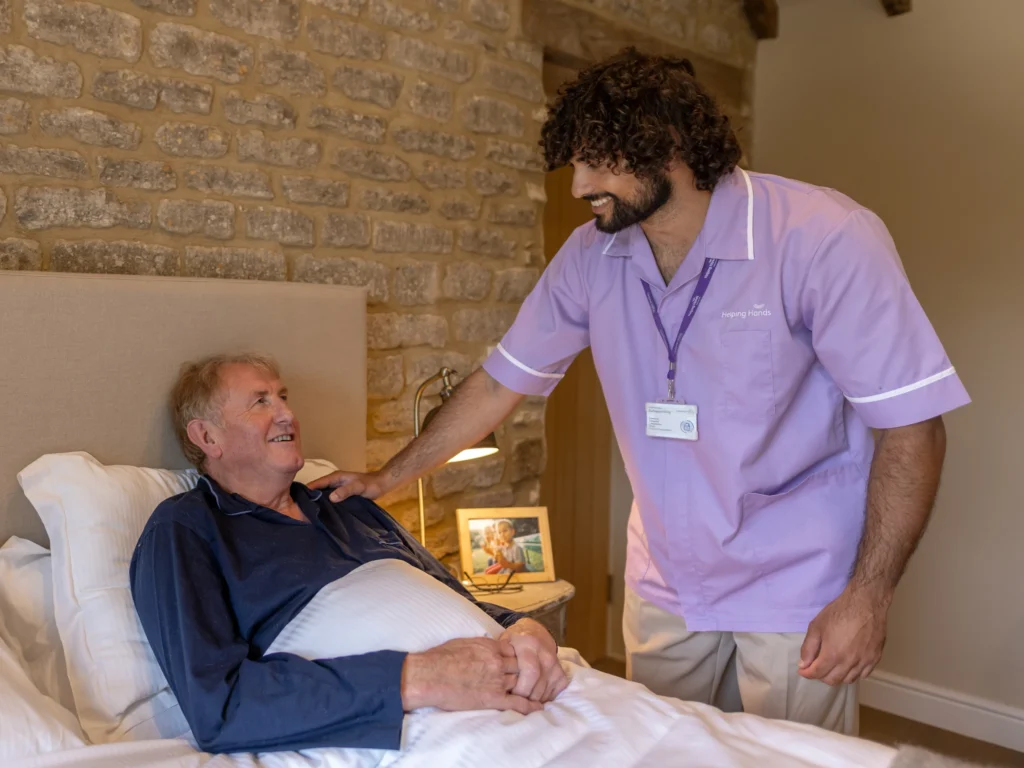
Settling back in at home with Helping Hands’ after hospital care
Because Helping Hands have been supporting people to live as independently as possible since 1989, including after hospital discharge, it’s no surprise we’re the UK’s most trusted home care provider.
Care that can start in as little as 24 hours
Helping Hands have a large branch network across England and Wales, all owned and operated by us. That means we have carers in your area ready to start work as soon as you need them, including in 24 hours in some circumstances. Our local care teams will work with your discharge team to ensure you’ll be well supported at home.
Visiting or live-in support over the festive period
We’re the visiting and live-in care experts, whether you need us for a few hours over the festive period or around the clock. We can have a carer in place quickly who will be there at key times of the day or night, whether that’s to support your medications needs, mobility, or just to help you regain full strength after your hospital discharge.
Nurse-led care for more complex recovery
Helping Hands truly are the post-hospital care experts; this is because we have our own team of clinical nurses who support our complex care packages and ensure your carer has all the skills they’ll need. We understand how being back in the home and community you love benefits not just your physical wellbeing but emotionally too.
Frequently Asked Questions
It will obviously be subject to a thorough discharge assessment; however, it is possible for someone to be discharged from hospital on Christmas Day in the UK. Whether you need a minimal discharge, where you need little or no care, or a complex discharge where you need more specialised care, you shouldn’t be discharged unless a comprehensive package of community support is in place.
According to the UK Government, “NHS bodies and local authorities should ensure that, where appropriate, unpaid carers and family members are involved in discharge decisions.” This means that people waiting at home have an opportunity to put across concerns they may have about the person returning home and the level of care they’ll need. Hospital trusts have a duty of care to ensure that the person is discharged to the most appropriate place, so that their recovery can continue. This may be the home with additional health and social care provision, a community bed-based setting, or in exceptional cases a residential or nursing home setting. If loved ones have concerns, they should always raise them with the discharge planning team.